
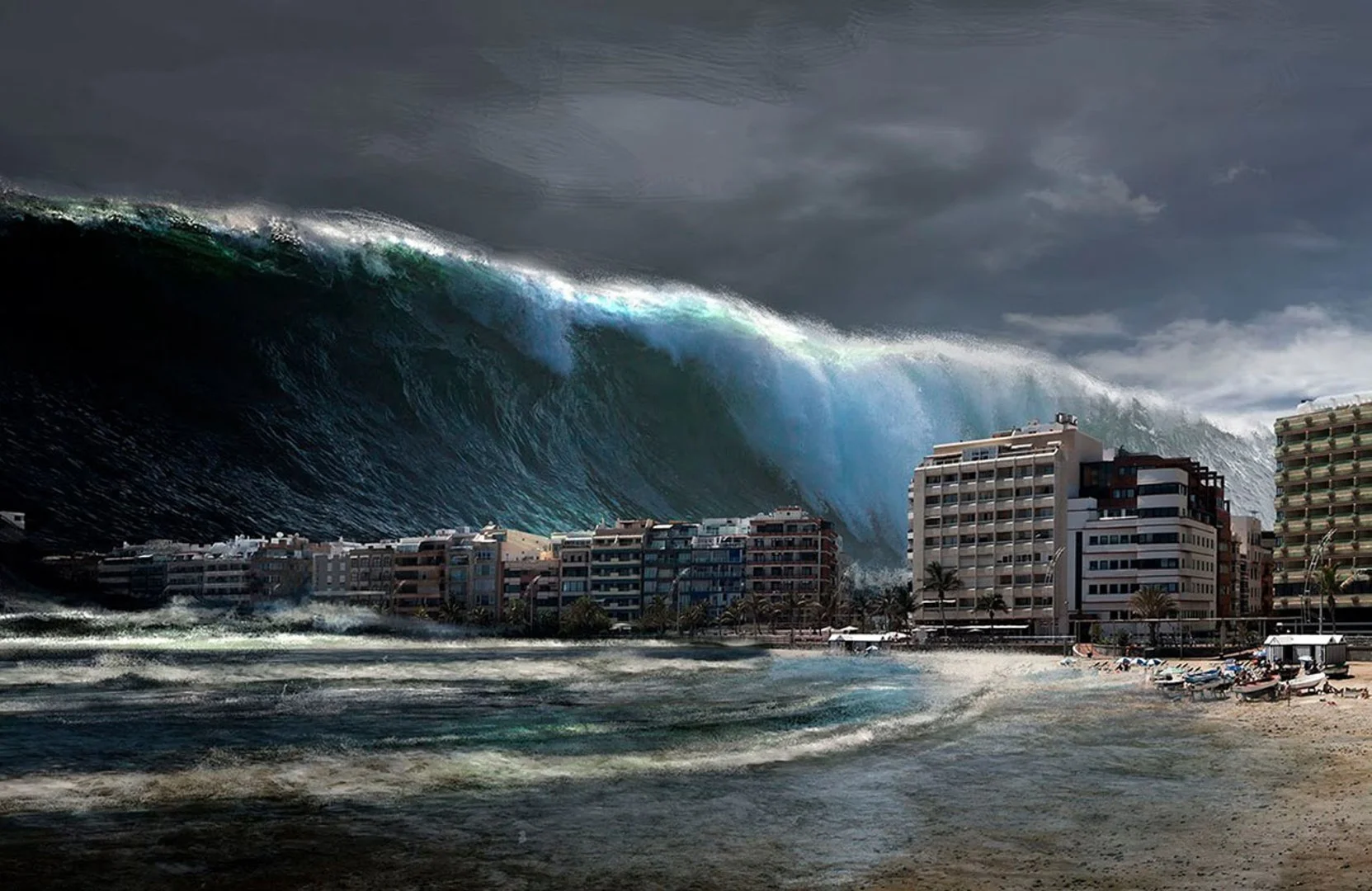
By: Colonel Arm Oke Kistiyanto, District Military Commander (Dandim 0602/Serang), Indonesia
Abstract
This article examines the potential consequences of a Sunda Strait megathrust event for Banten Province, with a particular focus on Serang City, Serang Regency, and the Cilegon–Serang energy-industrial corridor. The study uses a qualitative, scenario-based risk analysis grounded in peer-reviewed literature, official Indonesian disaster and geophysical sources, and technical references from the power and chemical safety sectors. The findings indicate that the principal hazard source is the subduction of the Indo-Australian Plate beneath the Sunda Plate along the southern Java–Sunda Strait margin. A major Scientific Reports study identified seismic gaps south of Java and modeled a worst-case tsunami of about 20 m along parts of the south coast of West Java if two major megathrust segments rupture simultaneously. A subsequent Natural Hazards study found that a megathrust-plus-backthrust configuration could produce tsunami heights of up to about 34 m near the Ujung Kulon Peninsula under a specific source geometry. For a more operational Banten-centered scenario, Indonesian tsunami modeling has estimated run-up of roughly 5.99 m and an evacuation window of about 40 minutes. The study further finds that western Banten’s critical infrastructure is unusually concentrated: the Suralaya coal-fired complex alone has 3,400 MW of installed capacity, while the Java–Bali interconnected grid reached a 2025 peak load of 44,940.80 MW. Consequently, a severe coastal disaster in the Cilegon–Serang corridor could trigger cascading impacts on electricity supply, logistics, public administration, and industrial safety. The article also argues that Cilegon’s chemical cluster faces a serious Natech risk, meaning natural hazards may trigger technological accidents such as toxic releases, fires, and environmental contamination. Overall, the paper concludes that a Banten megathrust scenario should be conceptualized not simply as an earthquake-tsunami event, but as a multi-domain crisis involving fatalities, infrastructure failure, industrial accidents, and governance disruption.
Keywords: megathrust; Sunda Strait; Banten; Serang; tsunami; critical infrastructure; power system; Natech
1. Introduction
Banten Province occupies a highly exposed position at the intersection of geodynamic hazard and strategic national infrastructure. Geologically, the province lies adjacent to the Sunda subduction system, where the Indo-Australian Plate converges with and subducts beneath the Sunda Plate. Institutionally and economically, Banten hosts industrial estates, ports, coastal tourism zones, major thermal power assets, and the provincial capital. BMKG’s seismic microzonation for Serang City explicitly notes that the area is affected by compressional tectonics associated with the Sunda Strait subduction environment and that infrastructure planning must account for local seismic response and subsurface characteristics.
Public discourse often treats a megathrust event as a narrowly geophysical problem: a large earthquake followed by a tsunami. That framing is insufficient for western Banten. In this region, an extreme offshore rupture could quickly evolve into a systemic crisis involving coastal fatalities, interruption of evacuation corridors, electricity disruption, industrial accidents, environmental contamination, hospital overload, and degradation of regional command-and-control capacity. OECD guidance on Natural Hazard Triggered Technological Accidents (Natech) stresses that installations handling hazardous substances may be seriously affected by earthquakes, floods, and related hazards, with consequences extending beyond the primary natural event into public health, infrastructure, and business continuity.
The purpose of this paper is therefore threefold. First, it reassesses the scientific basis for megathrust and tsunami hazard relevant to Banten. Second, it evaluates the spatial vulnerability of Serang Regency and Serang City, especially the Anyer–Cinangka coastal sector and the Kasemen area. Third, it analyzes the systemic implications for the Cilegon–Serang energy and chemical corridor, which functions as a strategic center of gravity for western Java.
2. Literature Review
2.1 Megathrust source potential south of Java and near the Sunda Strait
Widiyantoro et al. used relocated BMKG earthquakes and GPS inversions to identify clear seismic gaps south of Java and argued that these may represent future megathrust rupture zones. Their tsunami modeling showed that, in a worst-case scenario where two major megathrust segments rupture simultaneously, tsunami heights could reach approximately 20 m on the south coast of West Java and about 12 m on the south coast of East Java, with an average maximum height of 4.5 m along the southern Java coast. This result remains one of the most important open-access regional references for large-source tsunami hazard affecting western Java.
Supendi et al. extended that analysis to include southern West Java and southeastern Sumatra and introduced the importance of a backthrust component in the source model. Their simulations suggested maximum tsunami heights of up to roughly 34 m along the west coast of the southernmost part of Sumatra and the south coast of Java near the Ujung Kulon Peninsula. This does not imply a uniform 34 m tsunami across Banten; rather, it demonstrates that local source configuration and coastal geometry can sharply amplify hazard in the province’s southwestern sector.
2.2 Local site response in Serang City
BMKG’s 2020 seismic microzonation for Serang City provides a critical local-scale perspective. The study emphasizes parameters such as engineering bedrock depth, average shear-wave velocity to 30 m depth (Vs30), dominant period, seismic vulnerability, and ground shear strain. These parameters matter because damage is not controlled solely by earthquake magnitude; local soil conditions can intensify ground motion, alter frequency response, and increase the vulnerability of specific built-up districts.
2.3 Tsunami exposure in Serang Regency
BNPB’s contingency planning work for tsunami risk in Serang Regency reported that, according to InaRISK, 827 hectares fall into medium-to-high tsunami risk categories and four districts are potentially affected. This supports the broader assessment that western Serang, particularly the coastal frontage facing the Sunda Strait, requires dedicated preparedness planning rather than being treated as a peripheral hazard zone.
2.4 Natech risk in industrial corridors
OECD defines Natech accidents as technological accidents triggered by natural hazards such as earthquakes, floods, storms, or landslides. The guidance underscores that installations processing, storing, or handling hazardous substances can be vulnerable in principle and that such accidents may generate loss of life, health impacts, environmental pollution, infrastructure damage, and major economic disruption. This framework is directly relevant to Cilegon, where energy assets, industrial ports, bulk storage, and chemical processing are spatially concentrated.
3. Methods
This study employs a qualitative scenario-based risk analysis. It does not attempt to produce a single deterministic casualty count or a proprietary engineering fragility model. Instead, it synthesizes multiple evidence layers to identify the most consequential hazard pathways for Banten. The analysis proceeds in four stages: identification of primary hazards, assessment of spatial exposure, evaluation of critical infrastructure vulnerability, and appraisal of low-probability extreme scenarios against the scientific record.
The evidence base combines peer-reviewed studies on megathrust and tsunami hazard, official Indonesian hazard-planning documents, public electricity system statistics, and international chemical accident-prevention guidance. This mixed-source design is appropriate because the problem itself is interdisciplinary: the geophysical trigger, the built environment, the power system, and industrial accident risk must be analyzed as an integrated operational landscape rather than as separate technical silos.
A key methodological principle in this paper is the separation of high-confidence hazard findings from speculative claims. Megathrust source potential, tsunami modeling, local microzonation, and Natech risk are treated as evidence-supported analytical layers. By contrast, claims such as nuclear detonations directly triggering a regional Sunda megathrust rupture are tested against authoritative seismological evidence and assigned very low plausibility.
4. Results
4.1 Primary hazard: a large but variable tsunami envelope
The literature indicates that Banten faces not a single tsunami number but a hazard envelope. At the regional scale, worst-case south-Java megathrust scenarios can yield very large tsunami heights along western Java. At the local-western Banten scale, the Ujung Kulon sector appears especially sensitive under certain source configurations involving both megathrust and backthrust rupture. For operational planning, however, scenario estimates closer to Banten’s northern Sunda Strait-facing coast suggest lower but still highly destructive run-up and very short evacuation windows. The policy implication is straightforward: preparedness should not be keyed to a single “official” wave height, but to a range of plausible inundation severities.
4.2 Spatial pattern of impact in Banten, Serang Regency, and Serang City
At the provincial scale, the most heavily exposed districts are those fronting the Sunda Strait and the open Indian Ocean. This places Pandeglang in the highest exposure class, followed by the western coast of Serang Regency and the Cilegon area. Within Serang Regency, the Anyer–Cinangka corridor is the most critical frontage because it combines low-lying coastal morphology, concentrated tourism and settlement, direct marine exposure, and relatively constrained evacuation depth inland. BNPB’s planning figures for tsunami-exposed area in Serang Regency support the view that this is not a marginal risk zone but a core impact sector.
Serang City presents a different profile. The principal threat is less direct high-energy tsunami impact and more the combination of local ground amplification, disruption of utilities, hospital stress, administrative paralysis, and spillover displacement from harder-hit coastal districts. Within the city, the Kasemen area is relatively more exposed to coastal flooding and tsunami-related effects due to its low-lying northern setting, while more inland districts would likely experience lower direct inundation but remain vulnerable to seismic shaking and secondary-system failures. BMKG’s microzonation work strongly supports differentiated risk treatment within the city rather than treating Serang as a homogeneous urban area.
4.3 Casualty implications
Open public sources do not provide a single official province-wide fatality estimate for a specified Banten megathrust scenario. Nonetheless, spatial indicators are sufficient to infer the structure of likely losses. The highest fatality potential lies where four conditions converge: direct wave exposure, low elevation, high population or visitor concentration, and weak evacuation performance. By this logic, the greatest tsunami mortality burden in a major event would likely concentrate first in the exposed Pandeglang coastline, then in western Serang Regency, especially Anyer–Cinangka, and then in adjacent high-exposure coastal urban-industrial sectors. BNPB’s identification of medium-to-high tsunami risk across parts of Serang Regency, together with the city’s dependence on functioning transport and health systems, indicates that casualty risk is both coastal and systemic.
4.4 Power-system vulnerability
Western Banten’s role in the Java–Bali electricity system is strategically significant. PLN Indonesia Power reports that the Suralaya generating complex in Cilegon manages seven coal-fired units with a total installed capacity of 3,400 MW. PLN’s 2025 statistics show that the Java–Bali interconnected system reached a peak load of 44,940.80 MW. This means the western Banten corridor houses generation assets that are materially important to system stability, even if they do not represent a majority of total interconnected capacity.
The vulnerability of this corridor is not limited to generation blocks themselves. Switchyards, transformers, seawater intake systems, cooling infrastructure, transmission connections, and coastal access routes are all mission-critical nodes. An installation can remain structurally standing yet lose operational function if these supporting systems fail or flood. In a severe earthquake-tsunami sequence, the more realistic concern is therefore not an instantly permanent island-wide blackout, but a cascading sequence of partial outages, load shedding, and protracted staged recovery if multiple critical nodes are impaired simultaneously.
4.5 Chemical-industrial vulnerability and Natech escalation
Cilegon’s industrial character introduces an additional escalation pathway. Under OECD’s Natech framework, natural hazards can damage tanks, pipelines, cooling systems, control systems, and storage facilities, potentially triggering toxic releases, fires, explosions, and environmental contamination. In a densely interconnected industrial-port-energy corridor, these accidents may obstruct evacuation, expose nearby populations, and complicate emergency operations. This means that in western Banten a tsunami is not merely a flooding event; under certain conditions it can become the initiator of an industrial emergency complex.
4.6 Evaluation of extreme triggering scenarios
Claims that a distant or regional nuclear explosion could directly trigger a large Sunda megathrust event are not supported by the available seismological evidence. USGS states that nuclear explosions can induce small earthquakes and aftershock sequences, but such effects are generally much smaller than the explosion and limited to a few tens of kilometers from the shot point. USGS also notes that very large underground thermonuclear tests did not trigger damaging earthquakes in active tectonic regions at distance, and a classic USGS-linked analysis found no consistent relationship between explosion size and distant earthquake occurrence. These findings strongly argue against treating nuclear detonation as a credible primary trigger for a regional Banten megathrust scenario.
5. Discussion
The central finding of this study is that Banten’s megathrust problem is not purely geophysical. It is a systems-risk problem. The most exposed coastline may not be the location where the most serious governance consequences ultimately materialize. Western Serang’s coast may absorb the immediate marine impact, but Serang City bears a critical rear-area function: public administration, hospitals, shelters, logistics, and interagency coordination. If these functions are degraded by shaking, utility loss, or transport interruption, the overall regional response weakens, even if direct inundation is lower there than on the coast.
The same logic applies to the Cilegon–Serang infrastructure belt. The strategic problem is not simply the loss of megawatts. It is the interaction of coastal hazard with electricity generation, grid stability, industrial safety, port functionality, and hazardous-material management. In military-operational terms, the corridor acts as a critical support area whose degradation could have disproportionate effects on the theater-wide response. Preparedness in this environment therefore cannot rely on single-sector plans. It requires integrated evacuation planning, industrial emergency protocols, black-start and grid-recovery coordination, hospital continuity measures, and redundancy in command infrastructure.
This study also suggests that public communication should avoid false precision. Open-source science does not justify a single definitive casualty number or one guaranteed tsunami height for all of Banten. What the evidence does support is a structured hazard envelope and a clear hierarchy of spatial exposure. For policy and doctrine, that is enough to prioritize sectors, sequence resources, and identify which failures would be most operationally dangerous.
The study’s limitations are substantial but transparent. It does not use proprietary power-system contingency models, high-resolution local inundation grids for every village, or confidential chemical inventory data for industrial sites. As a result, it should be read as a strategic analytic paper rather than a replacement for detailed engineering studies. Even so, the open-source evidence is sufficiently strong to support the core conclusion that a Banten megathrust event could escalate into a multi-domain regional crisis.
6. Conclusion
A Sunda Strait megathrust scenario represents a credible, high-consequence threat to Banten Province. Peer-reviewed evidence indicates that the southern Java–Sunda Strait subduction system is capable of producing large tsunamigenic earthquakes, while local and regional modeling shows that western Banten may face severe coastal impacts under plausible source configurations. The most directly exposed sectors are Pandeglang and the western coastal frontage of Serang Regency, especially Anyer–Cinangka, while Serang City is critically vulnerable as an administrative, medical, and logistical support center.
The Cilegon–Serang corridor should be treated as a strategic infrastructure center of gravity. Its concentration of power generation, grid assets, industrial logistics, and hazardous installations means that disaster in this corridor could reverberate far beyond the shoreline. The appropriate policy response is therefore not a tsunami-only framework, but an integrated multi-hazard preparedness architecture linking coastal evacuation, urban continuity, power-system recovery, and Natech prevention and response.
Serang, 10 April 2026
-Oke02-
References
BMKG. (2021). Kerentanan seismik (mikrozonasi) Kota Serang tahun 2020.
BNPB. (2021). BNPB gelar workshop penyusunan rencana kontigensi menghadapi ancaman bencana tsunami di Serang.
OECD & European Union. (2024). Managing risks from natural hazards to hazardous installations (Natech): A guide for senior leaders in industry and public authorities.
PLN. (2026). Statistics 2025.
PLN Indonesia Power. (n.d.). Unit Bisnis Pembangkitan Suralaya / Suralaya Generation Business Unit.
Supendi, P., Widiyantoro, S., Rawlinson, N., et al. (2023). On the potential for megathrust earthquakes and tsunamis off the southern coast of West Java and southeast Sumatra, Indonesia. Natural Hazards, 116, 1315–1328.
USGS. (1970). Nuclear explosions and distant earthquakes: A search for correlations.
USGS. (2022). Can nuclear explosions cause earthquakes?
Widiyantoro, S., Gunawan, E., Muhari, A., et al. (2020). Implications for megathrust earthquakes and tsunamis from seismic gaps south of Java Indonesia. Scientific Reports, 10, 15274.
Komentar